


Flocculants Explained: Types, Uses and How to Choose
What a flocculant is, anionic vs cationic, gel blocks vs granular vs liquid, and how to pick the right one for your water. Free water test from Clearflow.
Muddy water is expensive. It can stall a dewatering job, put a discharge permit at risk, and fill a settling pond with fines that never seem to drop. A flocculant is often the fastest way to fix it.
This guide explains what a flocculant is, how it differs from a coagulant, the main types and forms, where each one fits, and how to choose the right product for your site. If you would rather skip ahead, send us a water sample and our lab will match it to the right Clearflow product for free.
What is a flocculant?
A flocculant is a chemical, usually a long-chain polymer, that grabs fine suspended particles like clay and silt and binds them into bigger clumps called floc. Floc is heavy enough to settle in a pond or basin, or to be caught by a filter, fabric or mat. The water clears, and turbidity (NTU) and total suspended solids (TSS) come down.
Because many contaminants ride on those particles, a flocculant can also pull down particle-bound phosphorus and metals. Clearflow's Gel Flocculant is designed to reduce TSS, turbidity, metals and phosphorus, and our FAQ notes that results have shown reductions in dissolved metals in many applications. How much depends on your water chemistry and the metals present.
Flocculant vs coagulant: what's the difference?
The two words get mixed up all the time. Here is the short version.
- A coagulant neutralizes the electrical charge on tiny particles so they stop repelling each other and start to clump. Coagulants are often metal salts or low-weight, positively charged polymers.
- A flocculant builds bridges between those particles, pulling them into large, heavy floc that settles or filters out fast.
Many treatment systems use both: coagulate first, then flocculate.
One caution. Many coagulants and some flocculants are cationic (positively charged), and cationic chemistry can harm fish if it reaches a stream. More on that below.
Types of flocculants: anionic, cationic and nonionic
Flocculants are grouped by their electrical charge. Charge decides what a flocculant grabs, how well it works on your water, and how safe it is downstream.
Anionic flocculants
Anionic flocculants carry a negative charge. They are the workhorse for mineral sediment like clay and silt from construction sites, haul roads, pits and ponds. Anionic polyacrylamide (PAM) is the most common example.
Peer-reviewed research cited in our fish-safe flocculant guide reports that anionic polymers are roughly 300 to 1,000 times less toxic to fish than cationic polymers. That is why anionic products are the usual starting point wherever treated water could reach a creek, lake or wetland.
Clearflow's anionic options:
- 300 Series Gel Flocculant: negatively charged blocks that form large floc that separates easily from the water.
- 400 Series Gel Flocculant: anionic blocks that help remove heavy metals and phosphorus.
Cationic flocculants
Cationic flocculants carry a positive charge. They work well on solids that are organic in origin, and on some stubborn clays. The catch is toxicity. A 2022 University of Alberta study found that even small amounts of unbound cationic polymer are highly toxic to rainbow trout, because the polymer collects on the gills and cuts oxygen uptake.
That does not rule cationic products out. It means they need tighter controls, and in many places regulatory sign-off, before treated water is released.
Clearflow's cationic option and its safety net:
- 600 Series Gel Flocculant: positively charged blocks for suspended solids that are organic in origin.
- Cationic Neutralizer 369: a negatively charged, faster-releasing block that neutralizes the positive charge of 600 Series blocks and other cationic flocculants and coagulants before water moves on.
Nonionic flocculants
Nonionic flocculants carry little or no charge.
Forms of flocculant: gel blocks, granular powder and liquid emulsion
Charge is half the decision. Form is the other half, because it decides how the flocculant gets into your water and how much equipment and labour that takes.
- Gel blocks and cartridges (floc blocks): Releases as moving water flows over it. Equipment: none for in-ditch use; a reactor for pumped flow. Best fit: ditches, culverts, pump discharges, storm mains, remote sites. Watch out for: needs flowing water to release.
- Granular or dry powder: Measured and mixed by hand or machine. Equipment: mixing and makedown gear for most uses. Best fit: batch treatment of ponds and tanks. Watch out for: needs careful measuring to avoid overdosing.
- Liquid emulsion: Metered by pump into the flow. Equipment: tanks, pumps, power and trained operators. Best fit: large active treatment systems. Watch out for: pump errors or load drops can leave excess polymer.
Gel flocculant blocks (floc blocks)
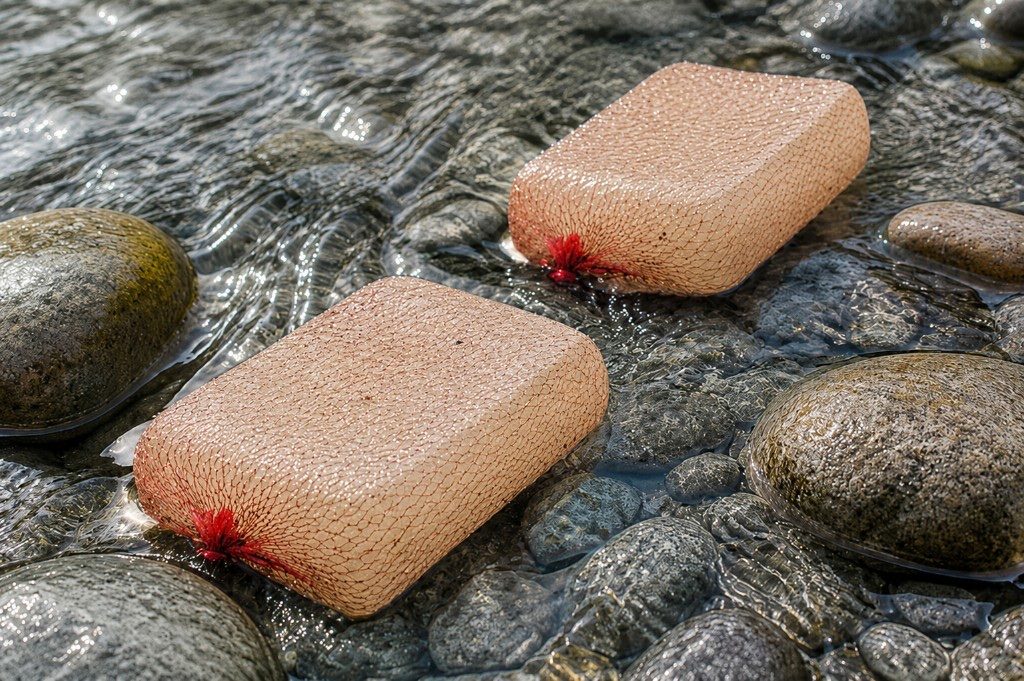
Gel flocculant blocks, often called floc blocks or flocculant blocks, are solid blocks of ready-state flocculant. You place them in the flow. As water moves past, the block slowly dissolves and doses itself.
Here is what Clearflow's product page says about its Gel Flocculant blocks:
- Passive and self-dosing. No makedown equipment, no power, no pumps to calibrate.
- Self-limiting. In still water the block swells but does not release. When flow picks up, say from spring runoff or pumping, it starts dosing again at a safe, effective level.
- Big coverage. A single block treats up to 40,000 cubic meters (up to 10.6 million US gallons) at flows of 50 to 100 US gpm. Water temperature, flow velocity, sediment load and system design all affect performance.
- Wide operating window. Works from pH 3 to 12, in fresh water and ocean water. In cold water you may need more gel flocculant, so tell us about your winter conditions.
- Quick to start. Blocks need at least 30 minutes in water before full release.
- Made in the USA and Canada.
For pumped water, Clearflow's GFR Water Treatment Systems hold gel cartridges in a stainless steel, flow-through reactor. The GFR 1000, 300, 100 and 100-P models treat higher flows in a smaller footprint, with no extra power beyond your site pump.
Granular and powder flocculants
Granular and dry powder flocculants are the classic choice for batch treatment, where you dose a known volume of water in a pond or tank. They store well and can be very effective. They also need accurate measuring and good mixing, and overdosing is a real risk if the sediment load changes.
Clearflow publishes Safety Data Sheets for several granular flocculants on its SDS page. Ask your representative which one fits your water.
Don't confuse a granular flocculant with UltraBind. UltraBind is a dry granular soil stabilizer that binds wet solids and turns slurry into a solid mass for transport or reuse. It solves the mud problem that comes after flocculation and dewatering, not the cloudy water problem.
Liquid and emulsion flocculants
Liquid flocculants, including emulsions, are pumped into the flow through a metering system. They allow precise dosing in large active treatment plants. The trade-off is equipment, power, operators and constant calibration. A pump error or a sudden drop in sediment load can leave unbound polymer in your discharge, which matters most when that water reaches fish.
Where flocculants are used
Construction stormwater and sediment control
Rain on a construction site turns exposed soil into muddy runoff fast. Flocculants help settle that sediment before it reaches storm drains, creeks and lakes. On construction sites, Clearflow Gel Flocculant goes into ditches, drains and pump discharges, paired with erosion and sediment control products that keep soil in place to begin with.
For municipal and developer stormwater management, Clearflow's work in Innisfil, Ontario, on Lake Simcoe used Gel Flocculant in storm mains and achieved more than 90% removal of TSS and phosphorus. Read the Lake Simcoe project.
Mining
Mines move a lot of water: pit dewatering, settling ponds, haul road runoff and surplus water headed for reuse or release. Flocculants are one of the main tools for clearing it.
See how Clearflow supports mining, from the Obed Mountain Mine spill response to a gold mine running Gel Flocculant and GFR 1000 systems. For a deeper dive, read our mine water treatment guide.
Dewatering
Excavations, ponds, pipelines and hydrostatic test water all have to go somewhere, and it usually has to be cleaner than when it started. A flocculant lets you treat and pump at the same time. On one pipeline project, Clearflow GFR1000 reactors treated 3.4 million gallons of hydrostatic test water from 28 miles of pipeline near Flint, Michigan, before discharge to the Flint River. See the pipeline project.
Aggregate wash plants and water polishing
Wash plants use huge volumes of process water, and recycling it saves money and keeps you running. At one Canadian aggregate wash plant, Gel Flocculant supported a 33,120 cubic meter per day recycle loop, with up to about $120,000 in avoided shutdown costs and release that surpassed project guidelines. Read the aggregate wash plant project. Past results are examples, not guarantees.
When water is almost clean enough, water polishing products finish the job. Clearflow's Floating Polishing Curtain, Treated Silt Mats and Treated Jute use flocculant-treated natural fibre to catch the ultra-fine particles that slip past primary treatment.
Are flocculants safe for fish and aquatic life?
It depends on the chemistry, the dose and whether there is any unbound polymer left in the water you release. Charge is the biggest factor. Cationic polymers can be toxic to fish at very low levels, while anionic polymers are far less toxic.
Here is what Clearflow can show you for its own products:
- Independent testing. Third-party testing with the University of Alberta and the National Research Council of Canada supports the aquatic safety of Clearflow Gel Flocculant, covering fish (adult and embryo) and Daphnia magna.
- Built-in overdose protection. Gel blocks release only into moving water and self-limit, which takes accidental overdosing out of the picture.
- A fix for cationic risk. Cationic Neutralizer 369 neutralizes the positive charge of cationic flocculants and coagulants.
- Regulatory listing. Washington State Department of Ecology lists Clearflow Gel Flocculant as an approved chemical under its C-TAPE program for chitosan-enhanced sand filtration systems.
Every SDS, the full toxicity reports and the University of Alberta research papers are free to download on our SDS page. For the full checklist, read How to Choose a Flocculant That's Safe for Fish and Aquatic Life.
Always check your own permit and regulator before you use any treatment chemical. They have the final say.
How to choose the right flocculant
There is no universal best flocculant. The right one is the one that matches your water. Here is how to find it without guesswork.
1. Know your water
Write down what you are treating and where it goes. Note your pH, temperature, sediment type (clay or silt), sediment load, flow rate and the volume you need to treat. Note your discharge limits and whether the water reaches fish-bearing streams.
2. Pick the charge
Start with anionic wherever treated water could reach a creek, lake or wetland. Consider cationic only for organic solids or water that anionic products cannot clear, and plan a neutralizer and regulatory approval if you do.
3. Pick the form
Flowing ditches, culverts and pump discharges suit gel blocks. Pumped flows at higher volumes suit a gel reactor. Batch ponds and tanks may suit granular products. Large active plants with operators on site may suit liquids.
4. Jar test before you buy
The only reliable way to know whether a flocculant will work on your water is to test it on your water. A jar test runs several products and doses side by side on a real sample, so you see which one clears fastest at the lowest dose.
5. Send Clearflow a sample
Our free water test does the jar testing for you. Here is how it works:
- Complete the site assessment. Tell us about your site, your water or soil, and what you need to treat. Do this before you ship anything.
- Ship a representative sample. Send 2 liters (half a gallon) of water per test type in a leak-proof container, with no refrigeration and no preservatives unless we ask. For soil, send 500 grams (1 lb). For slurry or mud, send 4 liters (1 gallon). UPS works well. Label the package as a water sample. We will send the shipping address once your assessment is in.
- In-house screening. Clearflow's in-house Professional Chemist screens your sample under site-relevant conditions.
- Get your report. You receive a clear technical report with a matched product. It costs you nothing, with no obligation.
6. Choose a supplier who backs it up
A good flocculant supplier tests your water first, sends the SDS and toxicity data fast, and has local support. Clearflow has offices in Sherwood Park, Alberta, and Phoenix, Arizona, plus a network of distributors across Canada, the US, the UK and Europe, Brazil and Australia.
Frequently asked questions
What is a flocculant in water treatment?
A flocculant is a chemical, usually a long-chain polymer, that binds fine suspended particles like clay and silt into larger clumps called floc. The floc settles or filters out, which lowers turbidity and total suspended solids. It can also carry down particle-bound phosphorus and metals.
What is the difference between a flocculant and a coagulant?
A coagulant neutralizes the charge on tiny particles so they start to clump. A flocculant bridges those particles into large, heavy floc that settles fast. Many systems use both, coagulating first and then flocculating.
Should I use an anionic or cationic flocculant?
Start with anionic if treated water could reach a stream, lake or wetland. Anionic flocculants work well on mineral sediment like clay and silt and are far less toxic to fish. Cationic flocculants suit organic solids but need tighter controls and often a neutralizer, such as Clearflow Cationic Neutralizer 369.
What are floc blocks and how do they work?
Floc blocks, also called flocculant blocks or gel flocculant blocks, are solid blocks of flocculant that sit in moving water and dissolve slowly as it flows past. They dose themselves, need no mixing or pumping equipment, and stop releasing when the water is still. One Clearflow Gel Flocculant block treats up to 40,000 cubic meters, depending on site conditions.
Are flocculants safe for fish?
It depends on the product. Cationic polymers can be toxic to fish at low levels, while anionic polymers are far less toxic. Clearflow Gel Flocculant has been through third-party aquatic safety testing with the University of Alberta and the National Research Council of Canada, and the reports are on our SDS page.
How do I find the right flocculant for my water?
Test it on your actual water. Clearflow offers a free water test: complete a short site assessment, ship a 2 liter sample, and our in-house Professional Chemist will match it to the right product and send you a technical report.
Get a flocculant matched to your water
Every site's water is different, and the right flocculant starts with a real sample. Tell us about your site and we will match your water to the right Clearflow product, with the SDS and toxicity documents your permit needs.
Next step
Match chemistry to your site water
Send a sample and our lab returns dosing rates, expected turbidity, and a recommended treatment train.
Request a water sample test