


Municipal/Stormwater
INNISFIL SEDIMENT EROSION CONTROL PILOT
FCM-funded Lake Simcoe pilot at Sleeping Lion: Gel Flocculant in storm mains cut pond sediment discharge ~74% in an extreme event and phosphorus ~90% across three SWMFs-about $2M in offsetting savings.

Location: Sleeping Lion subdivision, Town of Innisfil, Ontario, Canada
The Challenge
Innisfil, Ontario, on the southwestern shore of Lake Simcoe, needed to protect the lake from silt pollution and associated phosphorus in stormwater. The Lake Simcoe Protection Plan and LSRCA Phosphorus Offsetting Policy push new developments such as Sleeping Lion toward Zero Phosphorus release-or substantial offsetting fees (offset ratio 2.5:1; offset value about $35,770/kg/yr). Ontario SWMF guidelines target sediment ≥40 microns, but during extreme events most mass can be finer, including dissolved fractions under 2 microns that will not settle without Advanced Sedimentation Technology.
The Solution
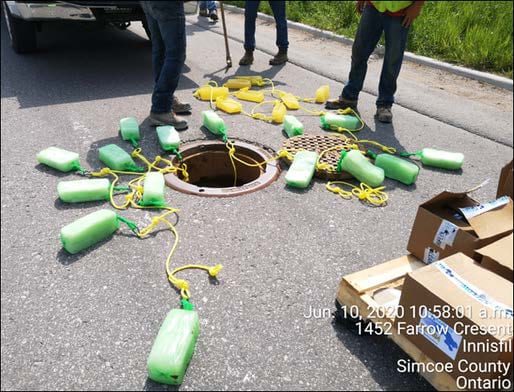
A $500,000 FCM Municipal Green Fund grant supported an ~$2M, 18-month pilot. Greenland Engineering selected Clearflow Gel Flocculants as the AST. After Clearflow lab matching, Gel Floc types 494 and 360 were installed in stormwater mains upstream of three SWMFs under construction. Blocks were strung in manholes so gravity flow doses the chemistry passively-leveraging existing infrastructure with almost no CAPEX.
Results
During a near 50-year rain event (~95 mm in 19 hours), about 36,000 kg of fine sediment washed from ~20 hectares of stripped subdivision-only ~9% >40 microns. With Gel Flocculant installed, particles <2 microns fell from ~44% to ~3% of mass, and that pond saw about a 74% reduction in sediments leaving the facility. Phosphorus was reduced by an average of about 90% across the three ponds-representing roughly $2 million in developer offsetting savings under LSRCA policy. Innisfil plans to add ASTs to development engineering specifications. Historical results are examples, not guarantees.
Field record
Proof from the field
Site photography, lab results and drawings recorded as the work was carried out.



Measured results
Delivered with our partners
Backed by a global distributor network
Clearflow projects are delivered with regional resellers and contractor-installers across North America, the UK & Europe, Brazil and Australia.
Find your regional partnerPartner with us
Want to deliver projects like this?
We're appointing resellers and installers in new territories.
Become a distributorNeed a site match?
Our lab matches your water or soil sample to the right Clearflow product - free jar testing available.