


How to Choose a Flocculant That's Safe for Fish and Aquatic Life
The safest flocculant for water that may reach fish-bearing streams is usually an anionic polymer backed by whole-product toxicity data and applied at a controlled dose. Here's how to compare charge, LC50 data, dosing and jar testing.
By Clearflow
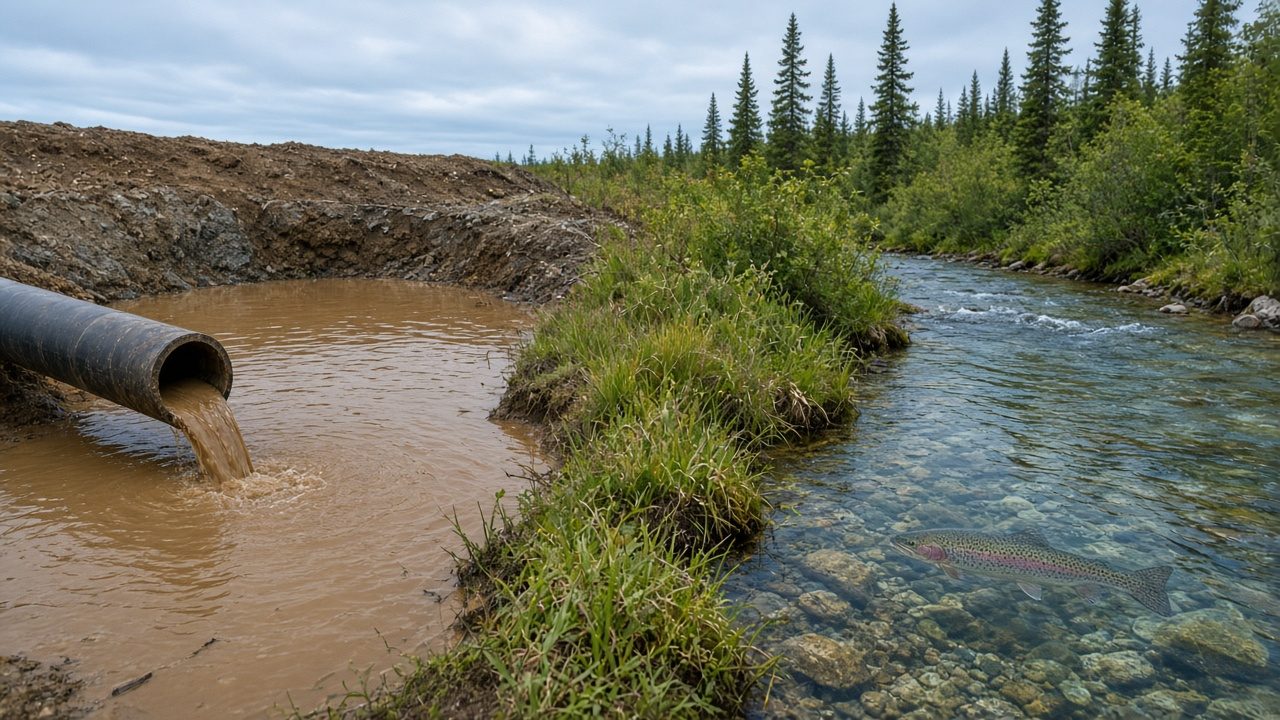
The safest flocculant for water that may reach fish-bearing streams is usually an anionic (negatively charged) polymer backed by whole-product acute toxicity data, such as 96-hour rainbow trout and 48-hour Daphnia magna LC50 results, and applied at a controlled dose. Cationic (positively charged) flocculants clear water well but are toxic to fish at very low concentrations, so they need extra controls, regulatory sign-off, or a neutralizer before discharge.
This guide covers what to look for, how to dose and monitor, and how to match a product to your construction, stormwater, mining or municipal dewatering site.
What is a flocculant?
A flocculant is a chemical, usually a long-chain polymer, that binds fine suspended particles such as clay and silt into larger clumps called floc. Floc is heavy enough to settle in a basin or be caught by a filter, fabric or sand bed. That lowers turbidity (NTU) and total suspended solids (TSS), and it can also carry down particle-bound phosphorus and metals.
Flocculants are grouped by charge: anionic (negative), cationic (positive) and nonionic (neutral). They come as liquids, granular or dry powders, and solid gel blocks.
Why toxicity matters: cationic vs anionic flocculants
- Cationic polymers work well on the negatively charged clays found at many sites. The catch is toxicity. In a 2022 University of Alberta study published in Aquatic Toxicology, researchers reported that even small amounts of uncomplexed cationic polymer left in treated water are highly toxic to fish, with an LC50 of roughly 0.3 mg/L. They found the main mechanism is hypoxemia: the polymer accumulates on the gills and reduces the fish's oxygen uptake (Clifford et al., 2022).
- Anionic polymers, such as anionic polyacrylamide (PAM), have been reported to be roughly 300 to 1,000 times less toxic than their cationic counterparts (Clifford et al., 2022, citing earlier work).
- A 2014 study in Environmental Toxicology and Chemistry exposed juvenile rainbow trout to 10 anionic PAM products for 7 or 30 days. Gill effects were minimal at an environmentally relevant concentration of 30 mg/L. A cationic reference product caused similar levels of gill damage at a concentration about 1,000 times lower (Kerr et al., 2014).
For transparency: both studies were carried out with the University of Alberta (the 2014 study also involved the University of Guelph's Fish Pathology Laboratory), and Clearflow staff were co-authors. You can download the full papers from our Safety Data Sheets and toxicity studies page.
Regulators agree. The U.S. EPA's 2022 Construction General Permit requires sites to get advance authorization from their EPA Regional Office before using cationic treatment chemicals such as cationic PAM, polyDADMAC or chitosan. Wisconsin DNR's Technical Standard 1051 sets allowable usage rates for water-applied additives based on whole-product toxicity data, and limits free acrylamide monomer in polyacrylamide additives that could reach groundwater to 0.05% by weight.
6 criteria for choosing an aquatic-safe flocculant
1. Charge
Start with an anionic flocculant wherever treated water could reach a stream, lake or wetland. If a cationic product is the only one that works on your water, plan for regulatory approval and a way to neutralize residual polymer before discharge. In the Clifford study, acute toxicity from a cationic flocculant was fully reversed when an anionic neutralizing polymer was added at ratios above 1:1.5 (cationic to neutralizer).
2. Toxicity test data
Ask the supplier for whole-product acute toxicity reports from an accredited lab, not just a "non-toxic" label. Look for:
- 96-hour rainbow trout LC50 (for example, Environment and Climate Change Canada method EPS 1/RM/13)
- 48-hour Daphnia magna LC50 (EPS 1/RM/14), a sensitive invertebrate test
- The lab, test date, product tested and concentration range
LC50 is the concentration that kills 50% of test organisms. A higher LC50 means lower acute toxicity. Compare it with the concentration the product will actually reach in your water. Section 12 (Ecological Information) of the SDS should summarize these results.
3. Residual and overdosing risk
Most aquatic harm comes from excess polymer that never attaches to a particle. Ask how the product prevents overdosing. With liquid systems, a pump calibration error or a drop in sediment load can leave unbound polymer in the discharge. Washington State's stormwater manual notes that the right dose matters for cost, performance, and avoiding aquatic toxicity (BMP C250).
4. Form: gel, granular or liquid
- Gel blocks sit in flowing water and dissolve as water passes over them. They need no mixing or dosing equipment, which suits remote ditches, culverts and pump discharges.
- Granular or dry flocculants suit batch treatment of ponds and tanks but must be measured and mixed carefully.
- Liquids and emulsions allow precise metering in active treatment systems but need tanks, pumps and trained operators.
5. Site conditions
Water chemistry changes results. Check pH, temperature, alkalinity, sediment type (clay vs silt), sediment load and flow rate. Washington's BMP C250 warns that a pH below 6.5 reduces performance and can itself be toxic to aquatic life. Gel products also need moving water to release.
6. Regulatory approvals and documentation
Confirm what your jurisdiction requires before you order. The EPA Construction General Permit requires treated water to pass through a sediment control before discharge, dosing per the supplier's specifications, and trained handlers. Some states keep approved product lists. Washington State Department of Ecology, for example, only allows chemicals approved under its C-TAPE program for construction stormwater treatment. Keep SDSs, toxicity reports and dosing records in your SWPPP or erosion and sediment control plan.
How to dose and monitor a flocculant
- Jar test first. Collect a representative sample and test several products and doses side by side. Washington's BMP C250 states that the only way to know whether a polymer will work for a specific application is preliminary or on-site testing.
- Set a baseline. Record influent turbidity (NTU), TSS if required, pH and flow.
- Start low and adjust. Use the lowest dose that meets your target.
- Give floc a place to settle. Route treated water to a sediment basin, settling tank, filter or treated fabric curtain before discharge, as the EPA permit requires.
- Monitor the discharge. Check effluent turbidity and pH regularly, and more often during storms or when pumping rates change. Compare the results with your permit limits and with conditions in the receiving water.
Where Clearflow fits
Clearflow Group, based in Sherwood Park, Alberta, makes water treatment products for construction, stormwater, mining and municipal sites.
- Gel Flocculant blocks are passive, self-dosing and need no makedown equipment. The 300 Series is anionic. The 400 Series pretreats suspended solids so they bind more easily with 300 Series blocks. The 600 Series is cationic and is used for solids of organic origin. Cationic Neutralizer 369 is a negatively charged, faster-releasing block that neutralizes the positive charge of 600 Series blocks and other cationic flocculants and coagulants.
- Published toxicity data. Lab reports for Gel Flocculant 394 show a 48-hour Daphnia magna LC50 of 1,415 mg/L and a 96-hour rainbow trout LC50 greater than 2,500 mg/L, with no trout deaths at any concentration tested (Alpha Laboratory Services, 2010, Environment Canada EPS methods). The SDS for each product, the full lab reports, and the research papers are on our SDS page.
- Regulatory listing. Washington State Department of Ecology lists Clearflow Gel Flocculant as an approved chemical under C-TAPE for use in chitosan-enhanced sand filtration (CESF) systems, after toxicity testing (Ecology approval).
- Site fit. Gel blocks work across a pH range of 3 to 12 and need at least 30 minutes of hydration before full release. One block covers up to 40,000 m³ at flows of 50 to 100 US gpm, depending on water temperature, flow velocity, sediment load and system design. For pumped water, the Gel Flocculant Reactor (GFR) holds gel cartridges in line.
Clearflow products are used in mining for pit and pond water and in stormwater management for passive clarification. At Lake Simcoe, Ontario, Clearflow treatment of stormwater achieved more than 90% removal of TSS and phosphorus.
Frequently asked questions
What is the safest type of flocculant for fish?
Anionic flocculants are generally the safest choice. Peer-reviewed research reports that anionic polymers are roughly 300 to 1,000 times less toxic to fish than cationic polymers. Always check the product's own trout and Daphnia test data.
Why are cationic flocculants toxic to aquatic life?
Positively charged polymers stick to fish gills and reduce oxygen uptake. Research from the University of Alberta reported fish toxicity at roughly 0.3 mg/L of unbound cationic polymer.
What does LC50 mean on a flocculant SDS?
LC50 is the concentration of a product that kills 50% of test organisms over a set period, such as 96 hours for rainbow trout or 48 hours for Daphnia magna. A higher number means lower acute toxicity.
Can I use a cationic flocculant on a construction site?
Sometimes, but it takes more work. Under the U.S. EPA Construction General Permit, you need advance authorization from your EPA Regional Office. Pairing cationic products with a neutralizer, such as Clearflow Cationic Neutralizer 369, reduces the risk from residual polymer.
How do I know which flocculant will work on my water?
Run a jar test on a representative sample. Clearflow offers a free water test: send a 2 L sample and our in-house Professional Chemist will screen it and recommend a matched product.
Get a flocculant matched to your water
Every site's water is different. Send us a sample through our free water test, or contact our team about your dewatering, stormwater or mine water project. We will recommend a product, dose range and delivery setup, with the SDS and toxicity documents your permit needs.
Next step
Match chemistry to your site water
Send a sample and our lab returns dosing rates, expected turbidity, and a recommended treatment train.
Request a water sample test